ANNUAL REPORT ‘12
RESEARCH, DEVELOPMENT AND INNOVATION
83
• TASS Project – aims to develop multiple segments,
levels of intelligence and surveillance systems for
the design of a real-time monitoring solution
for airport security needs; one of the two major
projects for aviation integration currently under-
way.
• SECAIR Project – the objective is to launch a
product that enables the detection of high risks/
threats to safety/security, thus guaranteeing the
integrity of passengers and increasing their comfort,
regardless of the weather conditions.
• Smart-ER Project – seeks to provide mechanisms
that enable managers of large public spaces (such
as airports and train stations) to understand the
level of occupancy and use profile at any given
time, anticipate future events and act proactively
to avoid critical situations.
• G-AOC Project – seeks to develop a means of
creating obstruction charts for airports. The
project’s goal is to develop an innovative process
that will produce, in a short period of time, a digital
surface model (DSM), significantly reducing the
time needed to update airport obstruction charts.
• Traple Retail Project – A result of the TRAPLE
Project. Among other outputs, it analyses the flow
of persons in certain locations, typical paths taken,
behaviours and paths chosen by individuals or
groups, dwell time by age group and/or segment,
ratio of dwell time to movement, rest and shop
visits and the definition of hot and cold zones in the
commercial area.
9.3_ANA IN PROJECT
Created to transform the knowledge and creativity
of ANA, S.A. staff into concrete opportunities for im-
provement or new businesses, the ANA IN platform is
an environment for sharing and innovation. Staff mem-
bers are encouraged to share, develop and implement
new ideas in response to the challenges faced by the
company.
In 2012, several initiatives were undertaken under the
ANA IN project.
Project opportunities
The project opportunities module for the ANA IN
Project, was launched in April 2012, for evaluating
opportunities from a feasibility point of view.
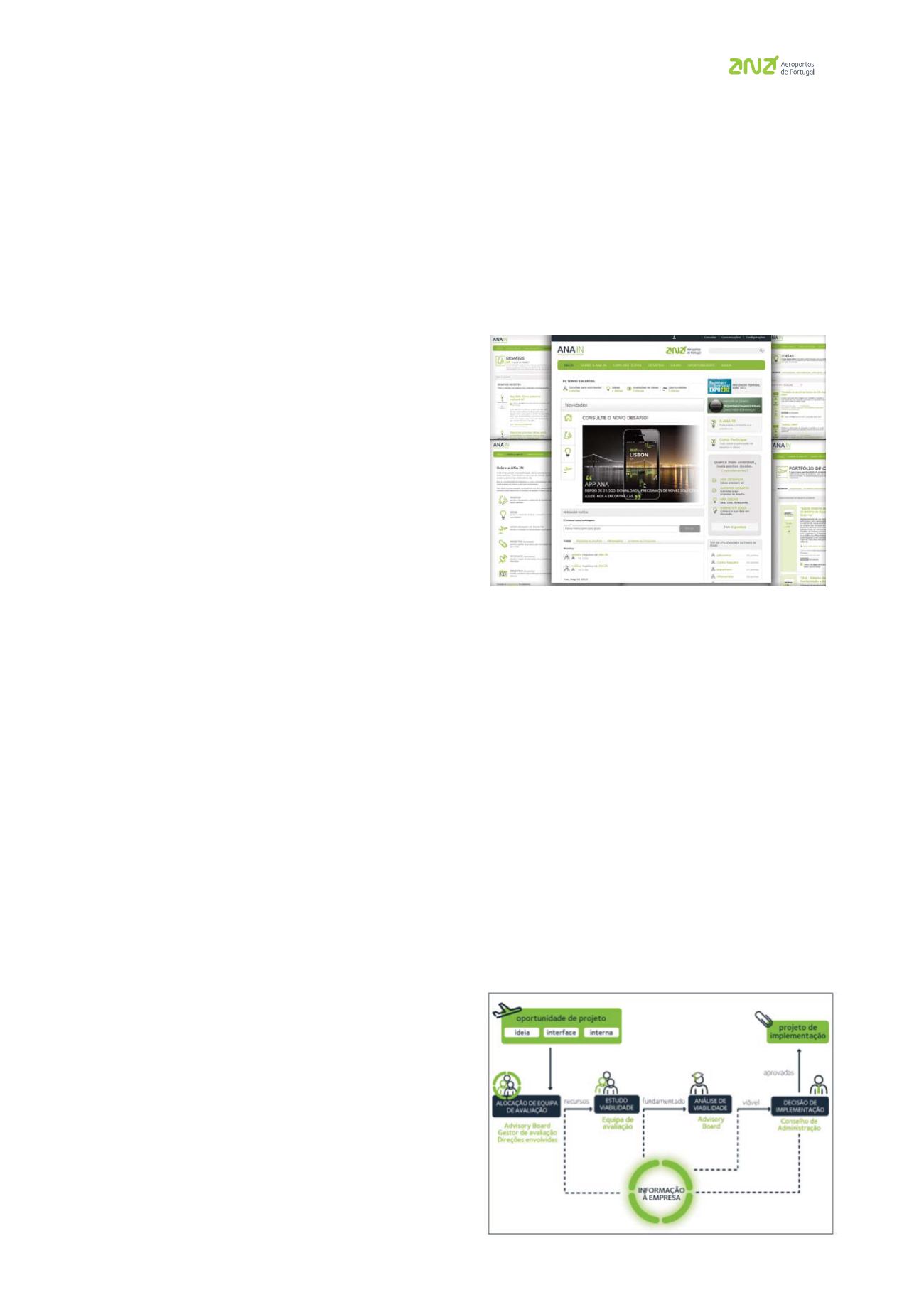
The development of a project opportunity involves the
creation of a work team to carry out the feasibility
study, from various points of view (technical, operational,
economic-financial), as a basis for future decisions
regarding its actual implementation.
The flowchart that supports the operation of the
module is shown in this figure:


