ANNUAL REPORT ‘12
ECONOMIC AND REGULATORY ENVIRONMENT
30
attract more and more passengers.
In spite of this trend, the number of low-cost air
carriers decreased in 2012 (especially in Europe), with
only the strongest companies being able to survive and
in the process improve their performance. The number
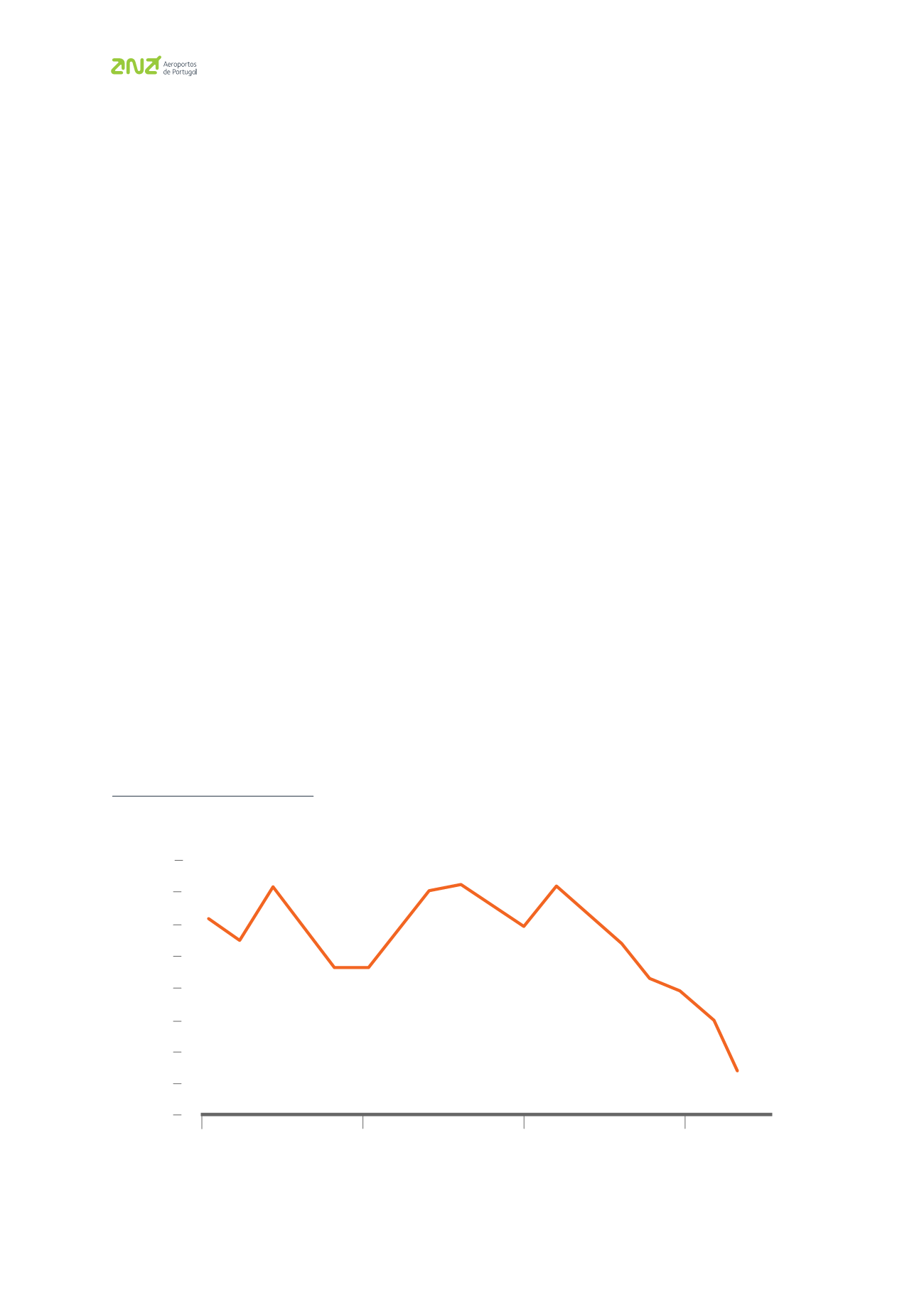
of new airlines has also decreased, a reflection of the
growing difficulty in obtaining financing for new invest-
ments.
The so-called traditional companies have been
forced to respond to these challenges through
consolidation and increased negotiation powers of
their alliances. Examples include the Continental-
United merger, the purchase of BMI (British Mid-
land International) by IAG (International Airlines
Group) and the possible merger of American Airlines
and US Airways.
Additionally, many of these airlines have revised
their business model, to adapt to new market
trends and have created their own low-cost airlines.
Examples of this strategy are Lufthansa, with its
Germanwings, IAG and its holdings Vueling and
Iberia Express, and the AF/KLM Group and its
subsidiary Transavia.
In the medium-haul sectors the biggest concern of
European airlines has been the competition from
low-cost airlines, but the long-haul carriers are
also under growing pressure from the exponential
growth in capacity offered by the so-called Gulf
airlines (Emirates, Ethiad and Qatar), which offer a
quality product with strong support from their
States.
Consolidation and restructuring: these are the
primary reasons given for the increased efficiency
in the air transport sector and, subsequently, for
the retention of earnings they have been able to
achieve in the face of rising costs. IATA revised its
projections upward for profits of the global aviation
industry for 2012, forecasting profits to the tune
of 6.7 billion dollars, over twice as high as it had
anticipated in June (three billion).
With tourism as one of the main motives for air
travel, it is equally interesting to note that in 2012,
Source: Ascend
160
140
120
100
80
60
40
20
0
1995
2005
2000
2010
NUMBER OF NEW AIRLINES FORMED


